

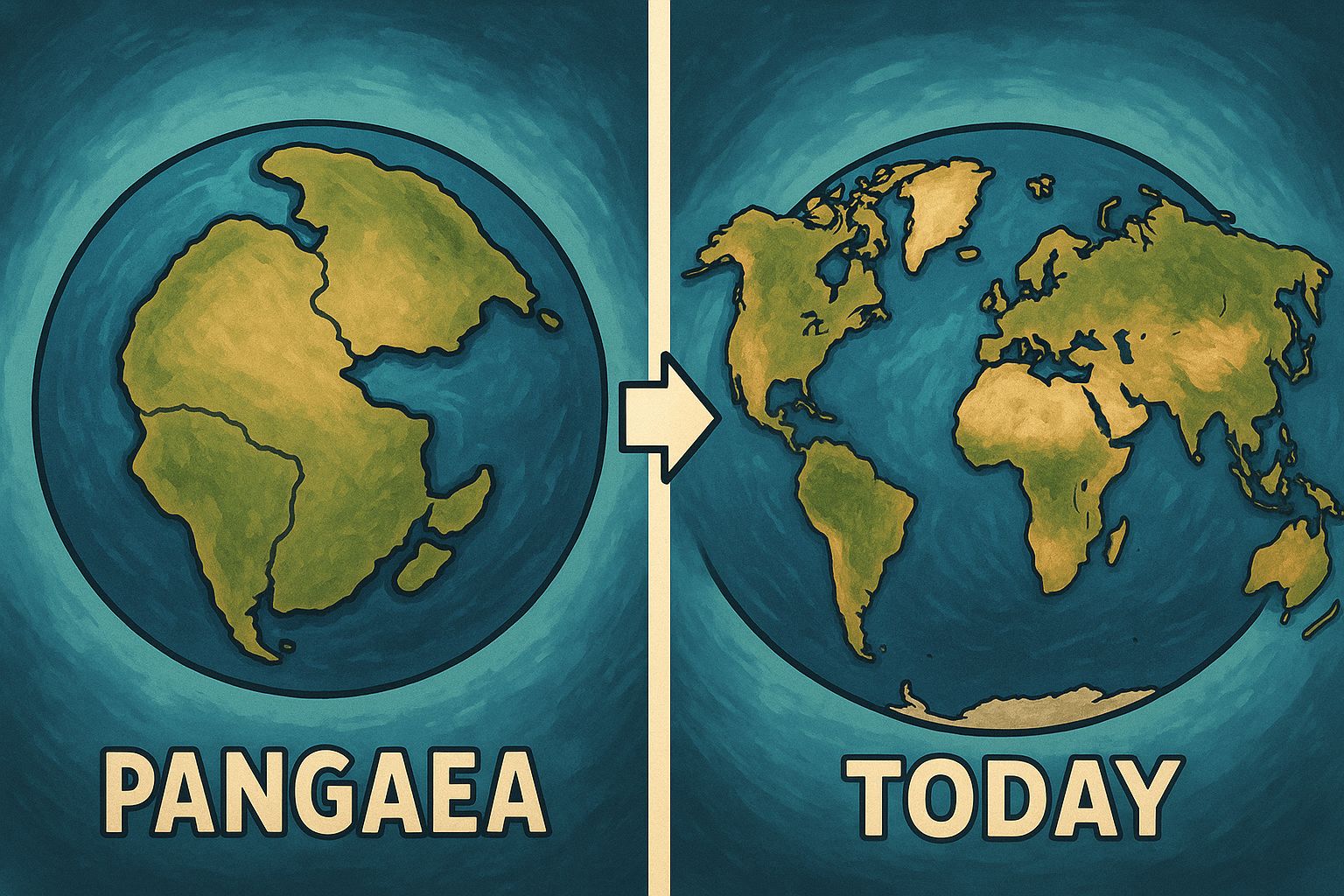
The photo above shows a powerful visualization of Earth’s ancient past—when all of today’s continents were once fused together in a giant landmass known as Pangaea. According to the Gemological Institute of America (GIA), this prehistoric supercontinent existed over 300 million years ago and began to break apart around 200 million years ago due to tectonic plate movement—a process still shaping our planet today.
One of the most compelling geological consequences of Pangaea’s breakup is the mirrored mineral composition found on opposite sides of the Atlantic Ocean. For example, certain gemstones and mineral deposits found in Brazil can also be located in West Africa—despite the vast ocean separating them.
This isn’t a coincidence. As GIA explains, the movement of Earth’s crust—known as plate tectonics—caused continents to drift slowly apart, carrying with them the mineral-rich formations that were once continuous. Before the split, what is now eastern South America was directly connected to western Africa. The mineral belts and host rock formations, particularly those containing pegmatites and beryls (which include gems like aquamarine and emerald), were unified.
In fact, GIA notes that Brazil and parts of Africa share geological “cratons”—ancient, stable sections of the Earth’s crust that formed the foundation for many of today’s gemstone deposits. These cratons help explain why both regions are famed for their colored gemstones and why their geology aligns so closely.
So when gemologists today identify similar tourmaline, topaz, or quartz varieties in Brazil and Africa, they’re looking at pieces of a shared geological story—written millions of years ago when the world was one.
Sources: All geologic references are based on information from www.gia.edu, the Gemological Institute of America.
Alex Fergi March 9, 2021
Gallery blocks have two settings: the number of columns, and whether or not images should be cropped. The default number of columns is three, and the maximum number of columns is eight. Below is a three column gallery at full width, with cropped images.
Robert Brown March 9, 2021
The default number of columns is three, and the maximum number of columns is eight. Below is a three column gallery at full width, with cropped images.
Ryan Berg March 9, 2021
The default number of columns is three, and the maximum number of columns is eight. Below is a three column gallery at full width, with cropped images.